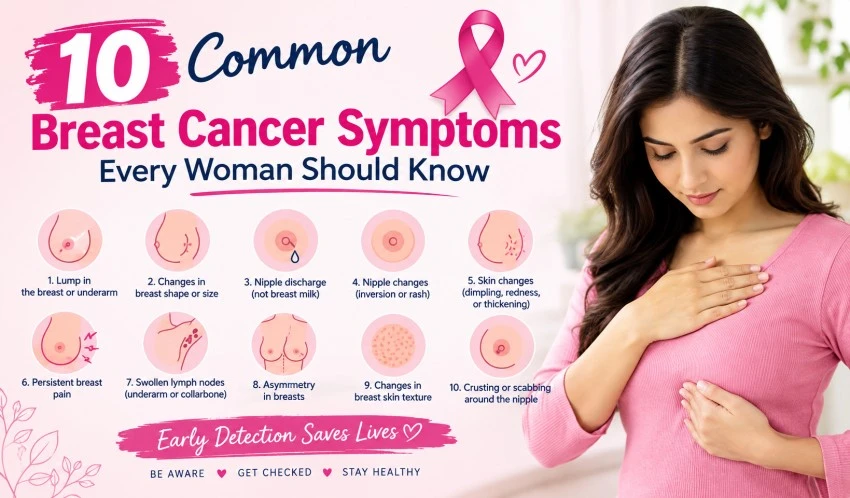
Breast cancer is the most commonly diagnosed cancer among women worldwide, and it is also one of the most treatable when found early. When it is caught at a localized stage, survival rates are very high. Yet many women delay seeing a doctor because they assume a change is harmless, or because they simply don’t know what to look for.
Knowing how your breasts normally look and feel is the first step. Breasts naturally change with the menstrual cycle, pregnancy, breastfeeding, and menopause, so the goal is not to panic over every change but to recognize the ones that are new, persistent, or unusual for you. Here are ten symptoms worth knowing about.
1. A New Lump or Thickening
A lump is the best-known sign of breast cancer, and it is often the first thing women notice. Cancerous lumps are typically hard, irregular in shape, and painless, though some can feel soft, round, or tender. A lump may also be a thickened area that feels different from the surrounding tissue rather than a distinct ball.
Most breast lumps turn out to be benign, such as cysts or fibroadenomas. But you cannot tell the difference by touch alone, so any new lump should be examined by a professional.
2. A Change in Breast Size or Shape
It is normal for one breast to be slightly larger than the other. What matters is a new change: one breast becoming noticeably larger, lower, or differently shaped. A tumor can alter the contour of the breast as it grows, sometimes causing a visible bulge or flattening in one area.
Looking in a mirror with your arms at your sides, then raised overhead, can help you spot asymmetry that you might miss otherwise.
3. Skin Dimpling or Puckering
If an area of skin looks pulled inward, creased, or dimpled, as though it is being tugged from underneath, take note. This can happen when a tumor grows near the surface and tethers the ligaments and tissue beneath the skin. The dimple may be subtle and easier to see when you lift your arms or lean forward.
4. Orange-Peel Texture
Skin that looks thickened and pitted, resembling the surface of an orange, is called peau d’orange (French for “orange peel”). It occurs when cancer cells block lymphatic vessels in the breast, causing fluid to build up and the skin to swell around the hair follicles. This sign is associated with more advanced or aggressive disease and should be evaluated promptly.
5. Redness, Warmth, or Rash on the Breast
Persistent redness, a rash-like appearance, or a feeling of warmth across part or all of the breast can sometimes be mistaken for an infection such as mastitis. However, if the redness covers a third or more of the breast and does not improve after a course of antibiotics, it could signal inflammatory breast cancer, a rare but fast-moving form. It often presents without any lump at all, which is why it is so frequently missed.
6. A Nipple That Turns Inward
Some women have naturally inverted nipples, and that is perfectly normal. The concern is a nipple that has recently begun to pull inward, flatten, or point in a new direction. This can result from a tumor behind or near the nipple drawing the tissue inward. Any new change in nipple position deserves a check.
7. Nipple Discharge
Fluid from the nipple is common and often harmless, particularly during pregnancy or breastfeeding, or after nipple stimulation. But discharge that is bloody, appears spontaneously without squeezing, comes from just one breast, or is clear and watery should be investigated. Milky, greenish, or yellowish discharge is more often linked to benign conditions, though only a doctor can confirm that.
8. Scaling, Flaking, or Crusting of the Nipple or Areola
Persistent itching, scaling, redness, or crusting of the nipple and the darker skin around it can look like eczema. But if it doesn’t respond to usual skin treatments, it may be Paget’s disease of the breast, a rare form of cancer that is often associated with an underlying tumor. Eczema rarely affects only one nipple, so a one-sided, stubborn rash is a reason to see a doctor.
9. Swelling or a Lump in the Armpit or Near the Collarbone
Breast cancer can spread to the lymph nodes under the arm or around the collarbone before a lump in the breast itself is noticeable. Swollen, firm nodes in these areas may be the first sign. Lymph nodes also swell for many harmless reasons, such as a cold or minor infection, but swelling that lasts more than a few weeks, or that appears without an obvious cause, needs attention.
10. Persistent Pain or Swelling in One Area
Breast pain is rarely a sign of cancer. Most cyclical tenderness is hormonal. However, a localized pain that doesn’t go away, or swelling of all or part of one breast even without a distinct lump, can occasionally be an early warning. Pay attention to discomfort that is new, stays in one spot, and doesn’t follow your menstrual cycle.
What to Do If You Notice a Change
Finding one of these signs does not mean you have cancer. The majority of breast changes turn out to be non-cancerous. But the only way to know for sure is to get checked, and early evaluation is always better than waiting.
Here is a sensible approach:
- Don’t wait for it to hurt. Early breast cancer is often painless, so lack of pain is not reassurance.
- Book an appointment. See a doctor within a couple of weeks of noticing a persistent change. Don’t wait several months to “see if it goes away.”
- Expect a thorough evaluation. This usually includes a clinical breast exam, imaging such as a mammogram or ultrasound, and sometimes a biopsy to examine the tissue.
- Note the details. Write down when you first noticed the change and whether it has grown or shifted. This helps your doctor.
Know Your Risk and Stay on Schedule
Certain factors raise the risk of breast cancer, including increasing age, a family history of breast or ovarian cancer, inherited gene mutations such as BRCA1 and BRCA2, early menstruation or late menopause, dense breast tissue, obesity, alcohol use, and previous radiation to the chest. Having risk factors does not mean you will develop the disease, and many women diagnosed have no known risk factors at all.
That is why regular screening matters. Recommendations vary by country and individual risk, but many guidelines suggest starting mammograms between ages 40 and 50 and continuing at regular intervals. Women with a strong family history or known gene mutations may need to begin earlier and may be offered additional screening such as MRI. Talk with your doctor about what is right for you.
Breast self-awareness is a helpful complement to screening. You don’t need a rigid monthly routine; simply become familiar with your breasts through everyday activities like showering or dressing, so that you notice quickly when something is different.
Men Can Get Breast Cancer Too
Although this article focuses on women, it’s worth remembering that men have breast tissue as well and can develop breast cancer, though it is far less common. The same warning signs apply, particularly a lump beneath the nipple, and men should not ignore them.
The Bottom Line
Early detection saves lives. A new lump, skin changes, nipple changes, unusual discharge, swollen lymph nodes, or persistent localized pain are all signals worth taking seriously. Most of the time they will prove to be nothing dangerous, but that reassurance is best given by a medical professional after a proper exam, not by guesswork at home.
Be familiar with your body, keep up with recommended screenings, and speak up when something feels off. Taking a few minutes to pay attention today can make an enormous difference in your health tomorrow.
This article is for general information only and is not a substitute for professional medical advice, diagnosis, or treatment. Always consult a qualified healthcare provider about any health concerns.