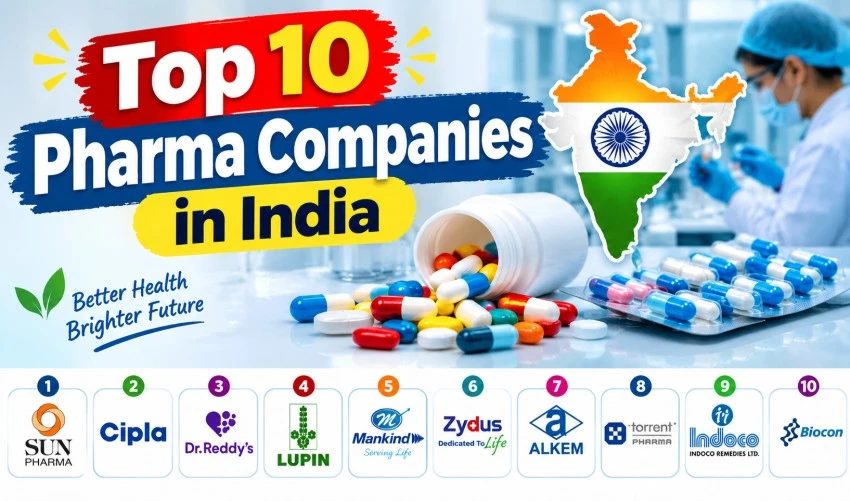
India is often called the “pharmacy of the world,” and for good reason. It is the largest global supplier of generic medicines by volume and supplies vaccines and active pharmaceutical ingredients (APIs) to markets across the world. Behind this reputation stands a group of large companies that combine manufacturing scale, research capability, and global reach.
This article profiles ten of the biggest pharma companies in India in 2026, ranked broadly by market capitalization. Rankings shift with share prices, and different sources use different cut-off dates, so treat the order as indicative rather than fixed.
How We Ranked These Companies
Pharma companies can be compared in many ways: revenue, profit, market value, R&D spending, or global footprint. This list leans on market capitalization as of mid-2026 because it reflects how investors view a company’s size and future prospects. We also considered business strength, product mix, and international presence. Market cap figures change daily, so check a live source before making any investment decision.
1. Sun Pharmaceutical Industries
Sun Pharma is India’s largest pharma company by market value. It reported FY2026 annual revenue of ₹58,462 crore, growth of about 11% year-on-year. Headquartered in Mumbai, it is the leading player in the Indian prescription market and has a major presence in the United States, where its specialty portfolio in dermatology and ophthalmology has become a key growth driver. Its Ilumya and Cequa brands are examples of this shift from plain generics toward higher-margin specialty medicines.
2. Divi’s Laboratories
Divi’s Laboratories is the country’s top API and intermediates maker, and it consistently sits among the top few pharma companies by market cap. Based in Hyderabad, it supplies ingredients to global drug majors, including custom synthesis for patented drugs. The company is known for strong profit margins, conservative debt, and long-term contracts with multinational clients. Its growth in nutraceutical ingredients and contrast media adds further diversity.
3. Torrent Pharmaceuticals
Torrent, based in Ahmedabad, has built a strong position in chronic therapies such as cardiovascular, gastrointestinal, and central nervous system medicines. Its branded business in India and Brazil is a steady earner. In recent years it has grown further through acquisitions that expanded its domestic footprint, and its market value has risen sharply as investors reward its consistent execution.
4. Cipla
Cipla is one of the most recognized names in Indian healthcare. Founded in 1935, it built its reputation on affordable respiratory medicines and was among the first to offer low-cost HIV/AIDS treatment to Africa. Today it is a leader in inhalers and respiratory care, with a strong consumer health arm and a growing presence in the US and South Africa. Cipla is also investing in complex generics and in new therapy areas.
5. Zydus Lifesciences
Zydus, formerly Cadila Healthcare, is a diversified group with branded generics, vaccines, biosimilars, animal health, and consumer products. It has been among the most active Indian companies in innovation, with a pipeline that includes novel molecules and biologics. Its US business gained from complex generics launches, while its Indian formulations business remains a solid base. Zydus is also known for developing vaccines for domestic use.
6. Dr. Reddy’s Laboratories
Dr. Reddy’s Laboratories is ranked sixth among India’s top pharma companies by market capitalization as of June 2026. The Hyderabad-based company is a global generics heavyweight with strong exposure to North America, Europe, Russia, and emerging markets. It has diversified into biosimilars, over-the-counter products, and digital health. Dr. Reddy’s is known for regulatory compliance experience, a deep product pipeline, and substantial R&D spending.
7. Mankind Pharma
Mankind is a relative newcomer to the stock market but one of India’s fastest-growing pharma companies. It focuses mainly on the domestic market, with deep reach in smaller towns and rural areas through a very large field force. Its portfolio spans acute and chronic therapies, and its consumer brands, such as Manforce and Prega News, are household names. The acquisition of Bharat Serums and Vaccines widened its presence in women’s health and critical care.
8. Lupin
Lupin, headquartered in Mumbai, is a major supplier of generics to the US and a leader in respiratory, cardiovascular, and anti-infective medicines. It has invested heavily in inhalation products, which are technically complex to develop and face less competition. Lupin also has a strong business in India, South Africa, and Latin America, and has been expanding its biosimilar and specialty efforts.
9. Aurobindo Pharma
Aurobindo is one of the largest Indian generic exporters, with a large share of revenue coming from the United States and Europe. It manufactures oral solids, injectables, and APIs, and it is vertically integrated, which helps control costs. The company has been working to build a presence in biosimilars, vaccines, and complex injectables, while keeping a wide global manufacturing network.
10. Alkem Laboratories
Alkem rounds out the group, with deep penetration in domestic anti-infective, gastrointestinal, and pain therapies. Its brands such as Clavam and Taxim-O are widely prescribed. Alkem was among the first Indian companies to launch a branded generic semaglutide in India in 2026, showing how quickly it moves on new opportunities. It also has a growing international business and a consumer-facing arm.
Honorable Mentions
Several other firms are worth watching. Biocon, India’s only large-cap biosimilars specialist, has a market cap of roughly ₹69,000 crore and has been rising strongly. Glenmark, Ipca Laboratories, Piramal Pharma, and Ajanta Pharma also command respect in specific niches such as dermatology, contract manufacturing, and branded generics.
Key Trends Shaping Indian Pharma in 2026
- Shift from generics to specialty. Leaders such as Sun Pharma and Dr. Reddy’s are moving toward higher-margin specialty and complex products, rather than relying only on plain generics where prices are under pressure.
- Biosimilars and GLP-1 drugs. Biologic medicines and weight-management therapies have become major opportunities, and several Indian firms are racing to launch affordable versions in domestic and global markets.
- Strong exports. Indian pharma exports crossed about USD 30 billion in FY25, and the sector remains a key foreign exchange earner.
- Technology and efficiency. Companies are adopting automation, data analytics, and AI to improve manufacturing quality and speed up drug discovery.
- Regulatory and pricing pressure. Domestic price controls and stringent inspections by foreign regulators like the US FDA continue to affect margins and require ongoing compliance investment.
- Steady long-term growth. The Indian pharma market is expected to grow at around 8–12% a year toward 2030.
What Makes These Companies Stand Out
Though each company has a different strategy, the leaders share several traits. They invest consistently in R&D, maintain high manufacturing standards that pass global audits, and diversify across geographies and therapy areas. They also manage costs well, often through backward integration into APIs, and they adapt quickly to new opportunities, from biosimilars to specialty launches.
A Note for Investors
This article is informational and not investment advice. Pharma stocks can be affected by regulatory actions, US pricing trends, currency movements, and patent expiries. Anyone considering investing should review recent financial results, check live market data, and consider consulting a SEBI-registered advisor. Diversified options such as pharma index funds can reduce the risk of depending on a single company.
Final Thoughts
India’s pharmaceutical sector is entering a new phase, moving from low-cost generics toward innovation, specialty products, and biologics. Sun Pharma leads in size, Divi’s dominates in APIs, and companies like Torrent, Cipla, Zydus, Dr. Reddy’s, Mankind, Lupin, Aurobindo, and Alkem each bring their own strengths. As healthcare demand rises both at home and abroad, these ten companies are well positioned to shape the industry’s growth through 2026 and beyond.
Market cap and revenue figures are approximate and based on mid-2026 data from public sources. Rankings change frequently, so verify current numbers on NSE, BSE, or company filings.