A high eosinophil count on a blood report can be alarming, especially when a quick online search mentions cancer. The most important thing to know is that no specific eosinophil level confirms or rules out cancer. In most people, raised eosinophils are caused by allergies, infections, or medications, not malignancy.
This article explains what eosinophils are, what counts are considered normal or high, and when high levels may point to a blood disorder or cancer.
What Are Eosinophils?
Eosinophils are a type of white blood cell made in the bone marrow. They help the body fight parasitic infections and play a major role in allergic reactions and asthma. They appear on a routine complete blood count (CBC) with differential, either as a percentage of white cells or as an absolute eosinophil count (AEC), measured in cells per microliter (cells/µL).
Normal Eosinophil Levels
Reference ranges vary slightly between laboratories, but typical values are:
- Percentage: about 1% to 6% of total white blood cells
- Absolute count: roughly 0 to 500 cells/µL
Eosinophil levels also vary through the day, tending to be higher at night and lower in the morning. Steroid use and acute stress can lower them temporarily.
Eosinophilia: Levels and Severity
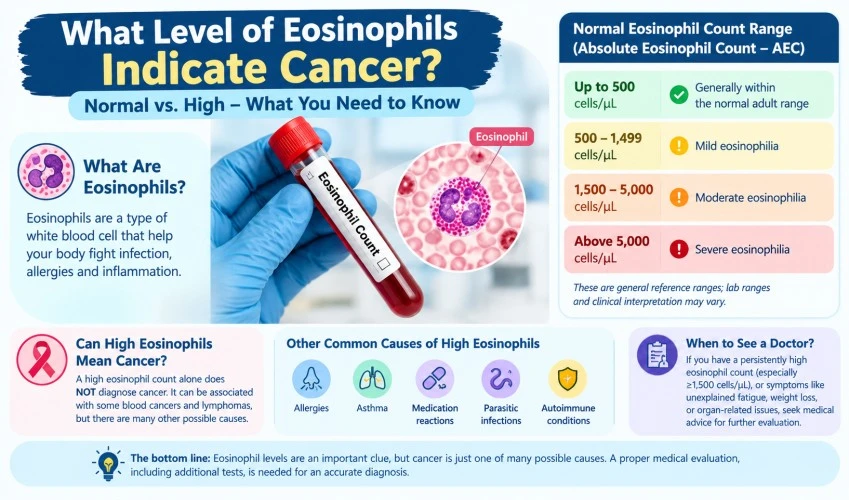
A count above 500 cells/µL is called eosinophilia. Doctors usually grade it as follows:
| Severity | Absolute Eosinophil Count |
|---|---|
| Mild | 500 to 1,500 cells/µL |
| Moderate | 1,500 to 5,000 cells/µL |
| Severe | Above 5,000 cells/µL |
A persistent count of 1,500 cells/µL or more is often called hypereosinophilia. If it is also linked to organ damage with no other cause found, the condition is called hypereosinophilic syndrome (HES).
These categories describe how high the count is. They do not tell you the cause. A person with an allergy or parasitic infection can have a count above 5,000, while someone with a blood cancer may have only mild elevation.
So, What Level Indicates Cancer?
There is no cutoff number. A mildly raised count is rarely a sign of cancer. Very high counts, especially above 1,500 cells/µL that persist for weeks or months without an explanation, deserve a thorough workup, because a small share of these cases involve a blood or bone marrow disorder.
Doctors look at the pattern rather than a single value:
- How long the count has stayed high
- Whether it keeps rising
- Whether other blood cells are abnormal
- Whether there are symptoms such as unexplained weight loss, fevers, or night sweats
- Whether there are signs of organ involvement
Common Non-Cancer Causes
Most cases of eosinophilia come from ordinary conditions:
- Allergies and hay fever
- Asthma and eczema
- Parasitic infections, particularly worm infections
- Drug reactions to antibiotics, anti-inflammatory medicines, and others
- Eosinophilic esophagitis and other digestive conditions
- Autoimmune diseases, such as eosinophilic granulomatosis with polyangiitis
- Adrenal insufficiency
- Skin conditions, including some forms of dermatitis
Because these are far more common, doctors usually investigate them first.
Cancers Associated With High Eosinophils
In some people, eosinophilia is a sign of an underlying cancer. It can happen in two ways: the eosinophils themselves may be part of the cancer, or they may rise in response to substances released by tumor cells.
Blood and Bone Marrow Cancers
- Chronic eosinophilic leukemia: a rare cancer in which the bone marrow overproduces eosinophils.
- Myeloid and lymphoid neoplasms with genetic changes involving genes such as PDGFRA, PDGFRB, FGFR1, or JAK2.
- Chronic myeloid leukemia (CML) and other myeloproliferative neoplasms.
- Acute myeloid leukemia, particularly a subtype with a chromosome 16 change.
- Systemic mastocytosis, a disorder of mast cells that can come with eosinophilia.
Lymphomas
- Hodgkin lymphoma is well known for sometimes causing raised eosinophils.
- T-cell lymphomas, including cutaneous T-cell lymphoma, may also be associated with eosinophilia.
Solid Tumors
Less commonly, eosinophilia has been reported with cancers of the lung, stomach, colon, cervix, ovary, and other organs, often when the cancer has spread. In these cases, it is called a paraneoplastic reaction. Eosinophils may also rise in some people receiving cancer immunotherapy, which is a treatment effect and not necessarily a sign of worsening disease.
Symptoms That Raise Concern
High eosinophils alone rarely cause symptoms. Doctors become more concerned when eosinophilia appears with:
- Unexplained weight loss
- Persistent fever or drenching night sweats
- Extreme fatigue
- Enlarged lymph nodes
- An enlarged spleen or liver
- Bone pain
- Easy bruising or bleeding
- Persistent itching or skin rashes
- Shortness of breath, chest pain, or heart symptoms
Eosinophils can also release substances that damage organs such as the heart, lungs, skin, and nerves when levels stay high for long periods. This is another reason persistent hypereosinophilia needs proper evaluation.
How Doctors Find the Cause
The workup usually moves step by step:
- History and examination, including travel, medications, allergies, and symptoms.
- Repeat CBC with a blood smear to confirm the count and look at cell shape.
- Basic tests for inflammation, organ function, vitamin B12, and tryptase.
- Stool tests for parasites, when relevant.
- Allergy and autoimmune testing.
- Imaging, such as a chest X-ray or CT scan.
- Bone marrow biopsy and genetic testing, if a blood disorder is suspected.
A hematologist is usually involved when the count is very high, persists, or the cause is unclear.
Should You Be Worried?
If your report shows mildly elevated eosinophils and you otherwise feel well, cancer is very unlikely. Many people simply have allergies or a recent infection, and the count settles once the trigger is treated or removed. A repeat test after a few weeks is often all that is needed.
Do not ignore a high count that stays elevated, climbs higher, or comes with the warning symptoms above. Early evaluation matters because treatment for many causes, including blood disorders, works best when started promptly.
Final Thoughts
There is no single eosinophil level that indicates cancer. Counts above 500 cells/µL are considered elevated, and persistent levels of 1,500 cells/µL or more need a careful search for the cause. Allergies, infections, and drug reactions explain most cases, while a minority are linked to blood cancers, lymphomas, or other tumors.
The best approach is to avoid self-diagnosis, discuss your complete blood count with your doctor, and follow through with any recommended repeat tests. Your symptoms, medical history, and the full blood picture matter far more than one number on a report.
Disclaimer: This article is for general information only and is not a substitute for professional medical advice, diagnosis, or treatment. Reference ranges vary between laboratories, so always interpret your results with a qualified healthcare provider.